
From the Sensex pack, NTPC, Tata Motors, Titan, Larsen & Toubro, Reliance Industries, IndusInd Bank, Infosys, HDFC Bank and Power Grid were among the major gainers. Wipro and Tech Mahindra were the laggards.

From the Sensex pack, NTPC, Bajaj Finance, IndusInd Bank, UltraTech Cement, Bajaj Finserv, State Bank of India, Tata Motors, ITC, Power Grid and Larsen & Toubro were the biggest gainers. IndusInd Bank climbed 2 per cent after the company on Tuesday reported a 30 per cent jump in consolidated net profit in April-June quarter at Rs 2,124.50 crore, helped by core income growth and lower bad loan provisions.

Tata Steel was the top gainer in the Sensex pack, rallying 3.23 per cent, followed by SBI, Yes Bank, Hero MotoCorp, ICICI Bank and Bharti Airtel.

The other prominent gainers were Tech Mahindra, HCL Technologies, Wipro, State Bank of India and Larsen & Toubro. Bajaj Finserv, Power Grid, UltraTech Cement and HDFC Bank were among the laggards.

IndusInd Bank was the top gainer in the Sensex pack, rising over 4 per cent, followed by HCL Tech, Bajaj Auto, Tech Mahindra, L&T and Kotak Bank.

Domestic markets are also aided by a rally in the global markets with US market surging to record high and a firming trend at other Asian bourses.

Market benchmark BSE Sensex rallied 635 points to 59,942 in the opening trade of the special Muhurat session on Monday to mark the beginning of Hindu Samvat year 2079. The 30-share index was trading higher by 635.12 points, or 1.07 per cent, at 59,942.27 in the first few minutes of trade. Similarly, the broader NSE Nifty surged 192.20 points or 1.09 per cent to 17,768.50.

Market regulator Sebi has barred 197 foreign funds, including those managed by global financial conglomerates like HSBC, Deutsche Bank and Standard Chartered, and 342 sub-accounts from further trading in stock market.

The dollar index was last trading up by 0.04 per cent against a basket of six major global rivals.

Equity flows have been under pressure since the second half of 2018, after the IL&FS crisis sent shockwaves in both equity and debt markets.

While inflows into Asia, including India, were expected to continue in 2011, there would be moderation.

The rupee extended its losses and slipped 12 paise to 77.74 against the US dollar in early trade on Thursday, weighed down by a muted trend in domestic equities and unabated foreign fund outflows. At the interbank foreign exchange, the rupee opened at 77.72 against the American dollar, then lost ground to quote at 77.74, registering a fall of 12 paise from the last close. On Wednesday, the rupee declined by 1?7 paise to close at its fresh lifetime low of 77.6?1 against the US dollar.

Equity benchmark indices ended flat on Wednesday with Sensex sliding 33 points and Nifty gaining 9 points after an unabated record-breaking rally in the last few trading sessions. Weak global market trends and fall in HDFC twins also spoiled markets party. The 30-share BSE Sensex dipped 33.01 points or 0.05 per cent to settle at 65,446.04.

Institutional investments in real estate may fall 20 per cent to $4 billion during this calendar year because of a higher inflow of funds in 2020, according to property consultant JLL India. During the January-September period, the institutional investment rose to $2,977 million from $1,534 million in the year-ago period. "Unless some large portfolio deals are not inked at the end of the year, annual investments are expected to be in the $3.8-4 billion range in 2021," JLL said in a statement. Institutional investments managed to cross the $5 billion mark in 2020 due to large portfolio deals worth $3.2 billion during the last quarter of the year.

The rupee on Wednesday declined by 16 paise to close at its fresh lifetime low of 77.60 against the US dollar amid unabated foreign fund outflows and a stronger greenback in overseas markets. At the interbank foreign exchange market, the rupee opened lower at 77.57 and later hit the day's low of 77.61 as the dollar rebounded in global markets following hawkish comments from US Federal Reserve chief Jerome Powell. Crude oil prices also surged over 1 per cent, which weighed on the rupee.

The rupee depreciated 40 paise to an all-time low of 81.93 against the US dollar in early trade on Wednesday as the strengthening of the American currency and risk-averse sentiment among investors weighed on the local unit. Moreover, a negative trend in domestic equities and significant foreign fund outflows sapped investor appetite, forex traders said. At the interbank foreign exchange, the rupee opened at 81.90 against the greenback, then fell to 81.93, registering a fall of 40 paise over its previous closing.

The broader 50-issue NSE Nifty slipped from its record closing, shedding 2.30 points or 0.02 per cent to end at 11,132.00.
The Sensex and the Nifty ended at fresh closing highs led by banks and index heavyweight RIL.

NTPC was the top gainer in the Sensex pack, rallying 3.44 per cent. Bharti Airtel, Bajaj Finance, TCS, HDFC twins, Yes Bank and RIL too gained up to 2.33 per cent.

'IPOs have performed exceptionally well, with a notable increase in average ticket size from Rs 800 crore in the last financial year to around Rs 1,300 crore in this financial year.'

M&M led the gainers' pack, spurting 2.76 per cent, followed by ITC, Kotak Bank, L&T, SBI, Bajaj Auto and Nestle India.

SBI was the biggest loser in the Sensex pack, tumbling 3.29 per cent, followed by Tata Steel, ICICI Bank and Maruti, which shed up to 2.76 per cent.

Domestic macroeconomic data announcements, global trends and trading activity of foreign investors would guide market sentiments this week, analysts said. After a record rally, markets may face volatile trends this week amid elevated valuations and investors would also keep a track of global oil benchmark Brent crude and rupee-dollar movement for further cues. "Potential volatility in the stock market is anticipated this week. Elevated valuations remain a concern, with investors now focusing on monsoon progress and its impact on the rural economy.

While FIIs have pumped in nearly Rs 17,000 crore, MFs have been net buyers to the tune of Rs 9,000 crore.

The primary market is expected to remain vibrant, with at least 10 companies, including supermart major Vishal Mega Mart and Blackstone-owned diamond grading firm International Gemmological Institute (India) Ltd expected to raise a combined Rs 20,000 crore in the next month, merchant bankers said. Education-focused NBFC Avanse Financial Services, TPG Capital-backed Sai Life Sciences, hospital chain operator Paras Healthcare, and investment bank DAM Capital Advisors are also among the companies planning to launch their IPOs in December, they added. The companies aim to raise a total of Rs 20,000 crore through their public offerings.

Bajaj Finserv was the top loser in the Sensex pack, shedding 4.57 per cent, followed by Infosys, TCS, Sun Pharma, HCL Tech, HUL, Dr Reddy's, HDFC and Reliance Industries. NSE Nifty plunged 181.40 points to 17,757.00.

The rupee fell by 41 paise to close at a fresh lifetime low of 79.36 (provisional) against the US dollar on Tuesday amid a strong greenback overseas and unrelenting foreign fund outflows. At the interbank forex market, the local unit opened at 79.04 against the greenback and witnessed an intra-day high of 79.02 and a low of 79.38. It finally settled at 79.36 (provisional), down 41 paise over its previous close.
Fresh investments through participatory notes (P-notes) are flowing into the cash market in huge quantum. The rush of investments is because foreign institutional investors (FIIs) have enough headroom to invest through P-notes.

Mutual funds' equity buying remained elevated for the fifth consecutive month in December, taking the net equity purchase past Rs 1.7 trillion in 2023. The aggressive buying in December indicates that flows into equity funds are likely to have remained unaffected by the sharp run-up in the market last month. Mutual funds (MFs) bought equities worth Rs 23,000 crore last month (until December 28) compared to Rs 18,000 crore in November, shows data from the Securities and Exchange Board of India (Sebi).
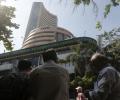
Yes Bank was the top gainer in the Sensex pack, soaring 24.03 per cent, after the lender said it had received a binding offer for $ 1.2 billion funding from an overseas investor. SBI, Infosys, Tata Motors, Bharti Airtel, HCL Tech and HDFC too rallied up to 7.69 per cent.

With outlook uncertain for a range of sectors, no one is quite sure of where to invest in stocks

Benchmark indices advanced for the second straight session on Tuesday, with the Sensex and Nifty jumping nearly 2 per cent each, mirroring a rally in global equity markets. Buying in index majors Reliance Industries and IT stocks buoyed the benchmarks. The BSE Sensex zoomed 934.23 points or 1.81 per cent to settle at 52,532.07. During the day, it rallied 1,201.56 points or 2.32 per cent to 52,799.40. The NSE Nifty climbed 288.65 points or 1.88 per cent to finish at 15,638.80.

Foreign portfolio investors' (FPIs') shareholding in NSE-listed companies fell 51 basis points sequentially to 17.68 per cent in the quarter ended March 31, 2024, according to data compiled by PRIME Database. This is the lowest FPI shareholding since December 2012. From the recent peak of 21.21 per cent at the end of December 2020, FPI shareholding is down 353 basis points.
The BSE benchmark Sensex rose 192 points to end at 39,250 on Sunday as investors built up fresh positions in the special Muhurat trading session to mark the beginning of Hindu Samvat year 2076.

Movement in the equity market this week will largely be dictated by quarterly earnings of blue-chip firms HDFC Bank and Hindustan Unilever, along with the announcement of WPI inflation data and global trends, analysts said. Trading activity of foreign investors, global oil benchmark Brent crude and rupee-dollar trend would also guide the movement.
Even as foreign institutional investors are rushing out of the Indian equity markets, there are fresh indications that their selling may accelerate in the coming weeks.

Domestic markets conduct a special one-hour Muhurat trading session on Diwali every year to mark the beginning of the traditional Hindu calendar year, called 'Vikram Samvat'.

Stocks of small- and mid-cap companies continued to gain ground in July, notwithstanding analysts sounding caution on these two market segments given the sharp run thus far in calendar year 2023 (CY23). Sanjeev Prasad, co-head of Kotak Institutional Equities, in a note co-authored with Anindya Bhowmik and Sunita Baldawa in June-end, had cautioned against the sharp run in small- and mid-caps. "We do not see any particular reason for the excitement in small- and mid-cap stocks.
